



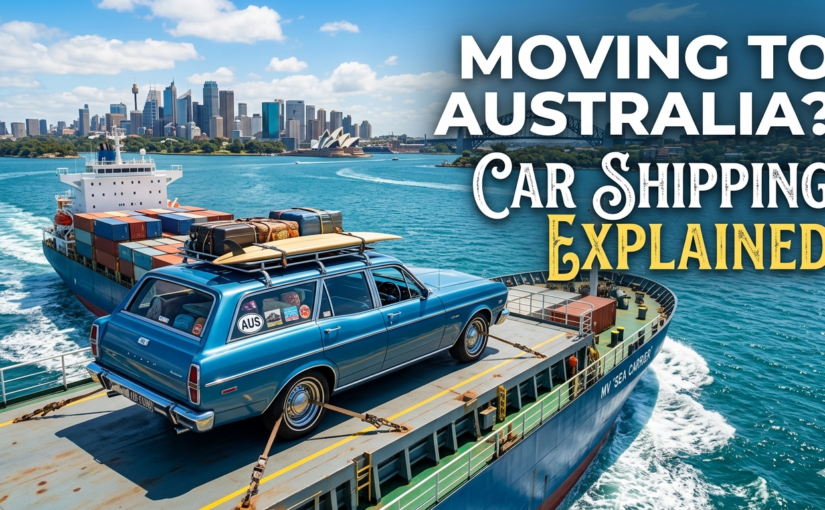
Moving to Australia? Here’s Everything You Need to Know About Shipping Your Car
Australia has a way of pulling people in. The lifestyle, the climate, the sheer sense of space and possibility — it’s no surprise that thousands of UK residents make the move every year. But once the excitement of a new life Down Under settles in, one very practical question tends to rise to the top: what do I do about my car?
Buying a vehicle fresh off the plane in Australia is possible, of course. But it’s also expensive, time-consuming, and means arriving in a country you may not fully know yet without the comfort of your own familiar wheels. Shipping your car from the UK is, for many people, the smarter, more personal, and often more economical long-term choice.
That said, shipping a vehicle to Australia is not the same as shipping it to Europe or even Canada. Australia takes its biosecurity extremely seriously, the distances involved are significant, and the import process has its own specific requirements that demand careful planning.
At Ship Cars Ltd, Australia is one of our most well-travelled routes. This guide covers everything you need to know — honestly and clearly — so you can move forward with confidence.
Before You Book: Can Your Car Be Imported?
The very first step before planning anything else is confirming that your vehicle is actually eligible to enter Australia. Not every car automatically qualifies, and there are a few key criteria to be aware of.
Australia’s vehicle imports are regulated by the Department of Infrastructure, Transport, Regional Development, Communications and the Arts (DITRDCA). For vehicles being imported as personal effects — meaning the car belongs to you personally and is being brought as part of a relocation — you’ll typically need to meet the following criteria:
- You must have owned and used the vehicle for at least 12 months prior to your departure from the UK
- The vehicle must be registered in your name before the import application is submitted
- Right-hand drive vehicles are strongly preferred in Australia, which works in your favour as a UK owner — Australia drives on the left, just like the UK
- The vehicle must comply with Australian Design Rules (ADRs) or be granted an exemption — older vehicles and certain classic cars may be exempt, while newer models may require compliance modifications
If your car doesn’t meet the personal effects criteria, there are alternative import pathways, but they involve additional costs and approvals. Our team can walk you through the options specific to your vehicle and situation.
Australia’s Biosecurity Rules — Don’t Overlook This
This is the section most people underestimate, and it’s arguably the most important part of the entire process.
Australia’s Department of Agriculture, Fisheries and Forestry (DAFF) enforces some of the world’s strictest biosecurity regulations. The country is an island ecosystem unlike any other, and protecting it from invasive species, soil contamination, seeds, insects, and plant or animal material is taken with complete seriousness.
What does this mean for your car? Simply put — it must be spotlessly clean before it leaves the UK.
Biosecurity officers in Australia will inspect your vehicle on arrival. Inspectors look for:
- Soil, mud, or clay — particularly in wheel arches, undercarriage, and tyre treads
- Seeds, leaves, straw, or plant material — even traces in floor mats or boot linings
- Insects — including any nesting in engine compartments or beneath the vehicle
- Animal material or faeces — inside or outside the vehicle
If contamination is found, the consequences fall entirely on you as the importer. These can include:
- Professional cleaning or fumigation at your expense at an Australian facility
- Re-export of the vehicle back out of Australia if contamination is severe
- In extreme cases, destruction of the vehicle
The most effective way to avoid all of this? Have your vehicle professionally cleaned before shipping — engine bay, wheel arches, undercarriage, boot, and interior — and ideally use an offshore treatment provider recognised by DAFF. Vehicles processed this way receive a reduced level of inspection on arrival, which speeds up the clearance process considerably.
At Ship Cars Ltd, we guide every customer through the cleaning and treatment requirements specific to their vehicle before departure.
Choosing Your Shipping Method: RoRo or Container?
Once eligibility and biosecurity preparation are sorted, the next major decision is how your car will make the journey. There are two primary options for UK to Australia shipping.
RoRo (Roll-on/Roll-off) Shipping
RoRo is available for standard, fully operational vehicles that can be driven on and off the vessel. Your car is driven onto a specialist ship at a UK port, secured for the voyage, and driven off again at the Australian port of arrival.
RoRo works well for:
- Standard cars and SUVs in good, drivable condition
- Customers seeking a straightforward shipping solution
- Vehicles heading to Port Kembla (Sydney), Melbourne, Brisbane, or Fremantle
One important note: personal belongings cannot be stored inside the vehicle during RoRo transit. Your car must be empty.
Container Shipping (Shared or Dedicated)
For vehicles requiring greater protection during the long voyage to Australia, container shipping is the premium option. Your car is loaded into a steel shipping container — either alone in a dedicated container or shared alongside other vehicles — providing shelter, security, and significantly reduced exposure to the marine environment.
Container shipping is ideal for:
- Classic cars, prestige, or high-value vehicles
- Non-runners or electric vehicles that cannot be driven
- Customers who want maximum protection over the 50+ day voyage
- Vehicles heading to Sydney, Melbourne, Brisbane, Adelaide, or Fremantle
An added benefit of container shipping for Australian imports is that biosecurity inspections for containerised vehicles are typically conducted at an unloading depot rather than at the wharf, which can simplify and speed up the clearance process.
Transit Times — Plan Well Ahead
Shipping from the UK to Australia is a long-haul journey, and realistic planning around timelines is essential. There are no shortcuts on this route.
Typical transit times from UK departure to Australian port arrival are:
- Melbourne — Approximately 50 to 55 days
- Sydney / Port Kembla — Approximately 50 to 55 days
- Brisbane — Approximately 50 to 55 days
- Fremantle (Perth) — Approximately 50 to 55 days
Beyond the sailing time, you’ll also need to allow:
- 3 to 7 days for loading and pre-departure processing at the UK port
- 3 to 5 working days after vessel arrival for unloading, customs clearance, and quarantine inspection
- Additional time if your vehicle requires cleaning, fumigation, or compliance work on arrival
In total, from the day you hand your car over in the UK to the day you collect it in Australia, you should plan for approximately 8 to 12 weeks end to end. Build this into your moving timeline early — don’t assume your car will be waiting for you when you land.
The Paperwork You’ll Need
Australian vehicle imports require a clear and complete set of documents. Gaps or errors here are one of the most common causes of customs delays. Here’s what you’ll typically need to prepare:
- Original V5C (Logbook) — The title document for your vehicle; the original must be provided, not a copy
- Valid Passport Copy — Photo page of the consignee
- Bill of Sale or Purchase Invoice — Confirming vehicle ownership
- Proof of Residency in UK — Supporting evidence that you lived in the UK prior to relocating
- Import Approval from DITRDCA — Required before your vehicle departs the UK
- DAFF Biosecurity Declaration — Completed as part of the import process
- Insurance Documentation — Proof of transit insurance cover
Australian customs will also assess applicable import duties and GST. If your vehicle qualifies as personal effects and meets the ownership and residency criteria, you may be eligible for a duty concession — a potentially significant saving worth discussing with our team before you book.
Protect Your Car for the Long Voyage
A 50+ day ocean crossing is not a short trip, and having proper transit insurance in place is simply non-negotiable for a journey of this length and distance.
At Ship Cars Ltd, we offer tailored transit insurance options for every vehicle we ship to Australia:
- Total Loss Cover — Protection in the event of catastrophic damage or loss during the voyage
- Comprehensive Damage Cover — Broader cover including structural and cosmetic damage sustained during loading, transit, and unloading
Before handover, photograph your vehicle thoroughly — every panel, every angle, the interior, the engine bay — and document all existing marks or damage in writing. This protects your claim fully if anything needs to be reported on arrival.
Let’s Get Your Car to Australia
Moving to Australia is a life-changing decision, and your car is part of making that new life feel like home. With the right preparation, the right shipping method, and the right team behind you, getting your vehicle there safely is far more achievable than it might seem.
At Ship Cars Ltd, we handle UK to Australia shipments every week. Our experienced team will guide you through biosecurity preparation, import approval, documentation, and every step of the journey — so you can focus on the exciting parts of your move.
Contact us today to get all the details about shipping requirements or check our sailing schedule for upcoming shipping dates.