



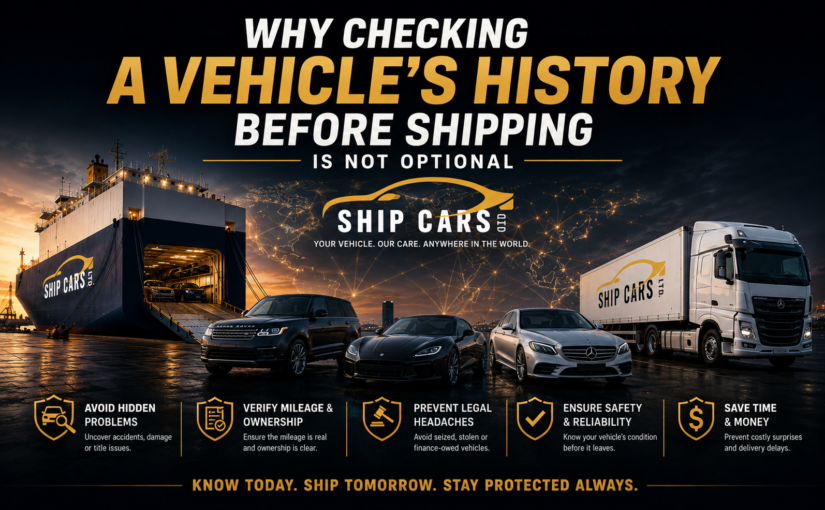
Buying a vehicle to ship overseas — whether you are a private individual purchasing a car for personal use abroad, a motor trader sourcing stock for export, or a business acquiring a fleet for international operations — carries a risk that is easy to overlook in the excitement of securing a good deal. That risk is simple: the vehicle you are about to ship might not be legally yours to ship.
Stolen vehicles are exported from the UK every year. Some are shipped knowingly by criminal networks. Many more are shipped unknowingly by buyers who purchased in good faith, paid a fair price, and had no idea that the vehicle they were loading onto a vessel had been reported stolen weeks or months earlier. The consequences for the innocent buyer are severe — the vehicle is seized, the money paid for it is gone, and in some cases the buyer faces investigation themselves.
At Ship cars ltd , we see this issue regularly enough to take it seriously. We do not carry out vehicle history checks on behalf of clients — that is not our role — but we do flag this risk clearly to every person who contacts us about shipping a vehicle they have recently purchased. This page sets out exactly what you need to check, why it matters, and how to protect yourself before you spend money on international shipping for a vehicle that could be taken from you at the port.
What Happens When a Stolen Vehicle Is Presented for Shipping
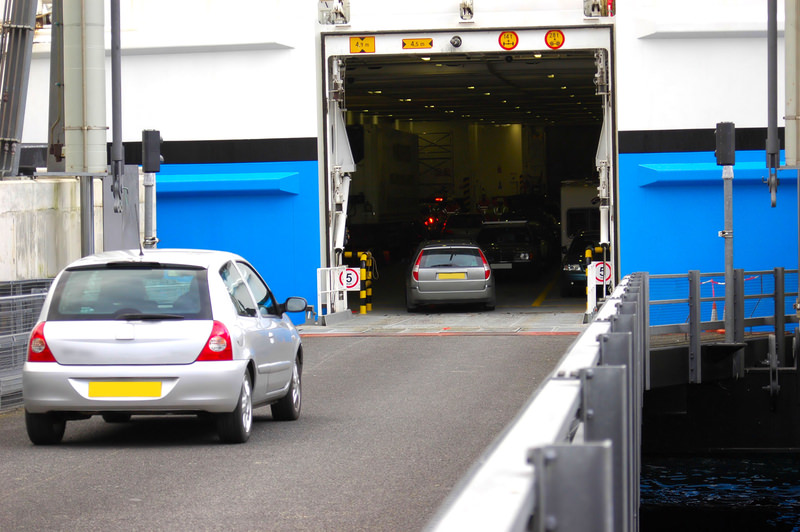
The port environment for international vehicle shipping is more closely monitored than many people realise. UK Border Force operates at all major departure ports and carries out checks on vehicles being exported. The Police National Computer (PNC) — which holds records of all vehicles reported stolen in the UK — is accessible to law enforcement at ports.
When a stolen vehicle is identified at the port, it is seized immediately. It does not matter whether the person presenting the vehicle for shipping knew it was stolen. The vehicle is treated as stolen property. It will not be released to the shipper, it will not board the vessel, and there is no mechanism for the buyer to recover the money they paid for it from the shipping company or the port.
The original owner — the theft victim — has a legal claim to the vehicle. The person who purchased it in the middle of the chain has no legal title, regardless of what they paid and regardless of whether they acted in good faith. This is the foundational principle of UK property law as it applies to stolen goods: you cannot acquire good title to stolen property.
Beyond the loss of the vehicle, a person found to be presenting a stolen vehicle at a port — even unknowingly — may face questioning by Border Force and potentially investigation by police. Proving innocent purchase is possible, but it is a deeply stressful and time-consuming process that no legitimate buyer wants to go through.
The Checks You Must Carry Out Before Buying a Vehicle for Export

This is not a box-ticking exercise. These checks exist to protect you, your money, and your shipment. Carry them out on every vehicle, without exception — regardless of how trustworthy the seller appears, how good the deal seems, or how urgently the purchase needs to be completed.
1. HPI Check — The Non-Negotiable Starting Point
An HPI check — or equivalent vehicle history check from a reputable provider such as Experian Autocheck, the AA, or RAC — is the single most important pre-purchase step for anyone buying a vehicle to ship internationally.
A comprehensive vehicle history check will confirm:
- Whether the vehicle has been reported stolen on the Police National Computer
- Whether there is outstanding finance secured against the vehicle — meaning the finance company, not the seller, may have a legal claim to it
- Whether the vehicle has been written off by an insurance company — which has significant implications for re-registration in many destination countries
- Whether the VIN (Vehicle Identification Number) and registration plate match — a mismatch is a major warning sign of a cloned or fraudulently registered vehicle
- Whether the mileage history is consistent with the vehicle’s age and service records
HPI checks are inexpensive — typically between £10 and £30 depending on the level of detail required. For a vehicle that may be worth thousands of pounds and is about to be shipped internationally at additional cost, this is not an area to economise on.
2. V5C Verification — Check the Logbook Carefully
The V5C registration certificate is the primary document confirming registered ownership of a UK vehicle. It is also one of the most commonly forged documents in vehicle fraud. Before purchasing any vehicle for export, examine the V5C carefully.
Look for the following:
- The registered keeper name and address should match the seller’s details. Ask for proof of address if there is any discrepancy
- The vehicle description — make, model, colour, engine size — should match the physical vehicle in front of you exactly
- The document reference number on the V5C can be checked directly with DVLA to confirm the document is genuine
- Watermarks and security features — genuine V5C documents have specific security printing. A V5C that looks faded, photocopied, or printed on plain paper is fraudulent
- The date of last keeper change — a vehicle that has changed hands very recently, particularly through a private sale, warrants additional scrutiny
3. VIN Plate Check — Physical Inspection of the Vehicle
The Vehicle Identification Number is stamped onto the vehicle itself in multiple locations — typically on a plate visible through the windscreen at the base of the dashboard, on the door sill, and on the engine bay. On modern vehicles it is also embedded in the vehicle’s ECU.
For any vehicle you are considering purchasing for export, physically inspect the VIN plate. Confirm that:
- The VIN plate has not been tampered with, re-stamped, or replaced
- The number matches exactly across all locations where it appears on the vehicle
- The number matches the V5C and any supporting documentation
- There are no signs of welding, grinding, or other physical alteration around the VIN plate area
A cloned vehicle — one where the identity of a legitimately registered vehicle has been copied onto a stolen vehicle — will typically show inconsistencies in the VIN locations. Any discrepancy is a reason to walk away immediately.
4. Outstanding Finance Check
A vehicle with outstanding finance secured against it is not legally free to be sold — and therefore not legally free to be exported. If you purchase a vehicle with outstanding finance and ship it internationally, the finance company retains a legal claim to the vehicle. This claim does not disappear when the vehicle leaves the UK. In some cases, finance companies have pursued vehicles across international borders and successfully had them seized at destination ports.
The HPI check will flag outstanding finance. Do not skip it.
5. Buy From Established, Traceable Sources
The risk of purchasing a stolen vehicle for export is significantly higher when buying through informal channels — social media marketplaces, cash-in-hand private deals with no paper trail, or sellers who are reluctant to provide documentation.
Buying from franchised dealerships, reputable independent traders, or established auction houses carries considerably lower risk, because these businesses operate with traceability, accountability, and reputational stakes in every transaction. For motor traders sourcing export stock, working with known auction houses and maintaining proper purchase records is not just good business practice — it is a meaningful layer of protection.
What to Do If You Discover a Problem After Purchase
If you carry out a vehicle history check after purchasing a vehicle and discover that it has been reported stolen, is subject to outstanding finance, or shows signs of identity fraud, stop immediately. Do not proceed with the export booking. Do not attempt to ship the vehicle.
Your immediate steps should be:
- Contact the police and report what you have discovered
- Retain all documentation relating to your purchase — receipts, bank transfer records, communications with the seller
- Contact your bank if payment was made by bank transfer — report it as a potentially fraudulent transaction
- Seek independent legal advice regarding your position as a purchaser in the chain
The fact that you discovered the problem and reported it proactively will be relevant to how authorities treat your position. Attempting to ship the vehicle regardless — even in ignorance — creates a far more difficult situation.
Real Examples from Ship cars ltd
A private buyer in London contacted us to arrange shipping of a BMW X5 he had purchased privately for export to Nigeria. During our standard pre-booking enquiry conversation, we asked whether he had carried out an HPI check. He had not. He ran the check before confirming the booking — and discovered the vehicle had outstanding finance of over £14,000 registered against it. The seller could not legally sell the vehicle. The buyer walked away before losing his money and his shipping costs.
A motor trader in the West Midlands shipping stock to Accra, Ghana had one vehicle in a consignment of six flag a VIN discrepancy at the port. The vehicle was seized by Border Force. The trader was able to demonstrate clean purchase documentation from a registered auction house — which significantly assisted the subsequent investigation — but the vehicle was not released and the purchase price was lost. The trader now runs HPI checks on every vehicle before it leaves the auction site.
How Ship cars ltd Approaches Vehicle Legitimacy
We are a vehicle shipping company, not an investigation service — and we want to be clear about that distinction. We do not carry out stolen vehicle checks on behalf of clients, and we cannot be held responsible for the legitimacy of vehicles presented to us for shipping by their registered owners.
What we do is this: we ask the right questions, we flag the risk clearly with every client who contacts us about a recently purchased vehicle, and we make sure that every person who ships with us understands the consequences of presenting a vehicle at port that turns out to have a problematic history.
Our job is to get your vehicle from the UK to its destination safely, legally, and efficiently. The checks described on this page are your responsibility — and they are straightforward to carry out. Do them before you book. Do them before you pay. Do them every time.
Because a genuine vehicle with a clean history is a shipment that goes smoothly from start to finish. And that is exactly what Ship cars ltd is here to deliver.
Ship cars ltd International RoRo and Container Shipping from the UK. Worldwide. Every Week.