



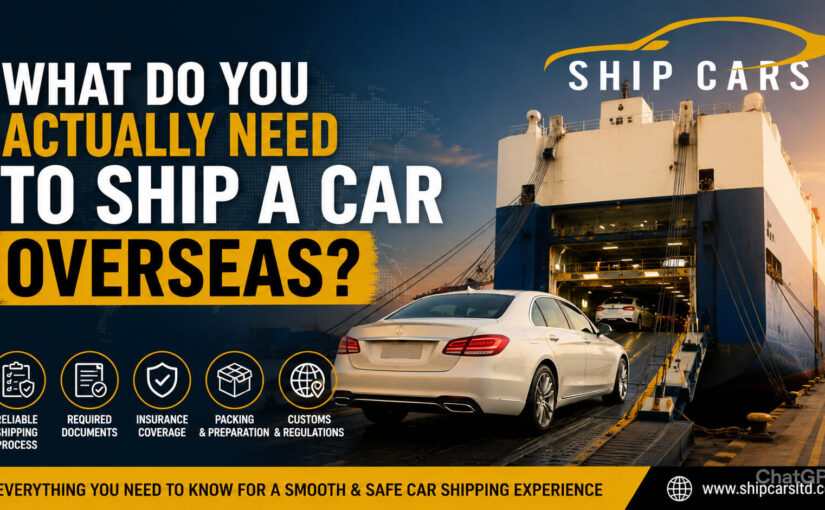
One of the most common questions we receive at Ship Cars Ltd is a simple one: what do I actually need to get my vehicle shipped internationally? It sounds straightforward, but the honest answer is that it depends — on your destination country, the type of vehicle you are shipping, whether you are using RoRo or container shipping, and whether you are a private individual or a motor trader.
What we can tell you with certainty is this: getting the documentation and preparation right before your vehicle reaches the port is the single most important thing you can do to ensure a smooth, stress-free shipment. Most delays, customs holds, and unexpected costs that arise during international car shipping are caused by incomplete or incorrect paperwork — not by anything that happens on the vessel itself.
This page sets out exactly what is required, covering the key documents, the practical vehicle preparation steps, and how Ship Cars Ltd manages this process on behalf of every client.
The Core Documents Required for International Car Shipping
Every international vehicle shipment from the UK requires a set of standard documents. Some of these are generated by us as part of the booking process. Others are your responsibility to provide. Here is a clear breakdown.
-
Proof of Vehicle Ownership
Before anything else, you need to be able to demonstrate that you own the vehicle you are shipping — or that you have the legal authority to export it. For UK-registered vehicles, the accepted documents are:
- V5C Registration Certificate (Logbook) — This is the primary document confirming registered ownership of the vehicle. The name on the V5C must match the name of the exporter. If you have recently purchased the vehicle and the V5C has not yet been updated, a receipt of purchase and a letter of authorisation may be accepted, but you should discuss this with our team in advance.
- Purchase invoice or receipt — Particularly important for motor traders and recent private purchases where the V5C is still pending transfer.
-
Valid Photo ID
A copy of your valid photo identification is required for all international vehicle shipping bookings. Accepted forms include:
- UK or international passport
- Full UK driving licence (with photo card)
For business accounts and motor traders, we will also require confirmation of the business name and registered address.
-
Proof of Address
Most destination countries require confirmation of the exporter’s residential or business address as part of the customs import process. A recent utility bill, bank statement, or council tax letter dated within the last three months is the standard requirement.
-
Bill of Lading
The Bill of Lading is the formal contract between the shipper and the shipping line. It confirms what has been shipped, from which port, to which destination, and in whose name. At Ship Cars Ltd, we generate and manage the Bill of Lading on your behalf as a standard part of the booking process. This document is critical — without it, your vehicle cannot be released at the destination port.
-
Export Entry / Customs Export Declaration
All vehicles leaving the UK require a formal customs export declaration to be submitted to HMRC via the National Export System (NES). This records the vehicle’s departure from the UK for customs purposes and is a legal requirement for all international shipments. We handle this on behalf of every Shipcars.co.uk client as part of our standard service — it is not something you need to arrange independently.
-
Vehicle Shipping Booking Confirmation
Your booking confirmation from Shipcars.co.uk acts as an official record of the shipment instruction and is required at port check-in. It confirms the shipping method — whether RoRo or container — the vessel name, the sailing date, and the destination port.
Additional Documents Depending on Destination
Beyond the core UK export requirements, individual destination countries impose their own import documentation requirements. These vary significantly and change regularly. The most common additional items include:
- Destination country import permit or pre-approval — Required in certain markets, particularly across West Africa and parts of the Middle East
- Certificate of Conformity — Required in some countries, particularly within the EU and certain African nations, confirming the vehicle meets local technical and emissions standards
- De-registration certificate — Some countries require formal evidence that the vehicle has been removed from the UK register before it can be registered locally
- Biosecurity or hygiene certificate — Required for all vehicles shipped to Australia and New Zealand. The vehicle must be professionally cleaned and inspected prior to export to comply with Australian DAFF (Department of Agriculture, Fisheries and Forestry) biosecurity requirements
At Ship Cars Ltd, we brief every client in advance on the specific documentation requirements for their destination country. We do not send a vehicle to a port without being confident that the paperwork is in order for both the UK export and the destination import.
Vehicle Preparation — What Needs to Be Done Before Shipping
Documentation aside, there are practical preparation steps that every vehicle must go through before it is accepted for international shipping. These apply whether you are shipping by RoRo or container.
Fuel level — For RoRo Vehicle shipping, the fuel tank must be reduced to approximately one quarter full or less. This is a standard requirement across all major shipping lines for safety reasons. Container shipments have similar guidelines depending on the shipping line and destination.
Battery condition — The vehicle battery should be in serviceable condition. For long-haul container shipments, it may be advisable to fit a battery isolator switch to prevent discharge during transit.
No personal belongings for RoRo — Vehicles travelling by RoRo must be completely empty of personal belongings. This is a non-negotiable rule enforced by all RoRo shipping lines globally. For container shipments, personal effects may be permitted depending on the destination country’s import regulations — we advise on this individually.
Alarm systems — Vehicle alarms should be disabled or deactivated prior to shipping to prevent triggering during the voyage. This is particularly important for RoRo shipments where the vehicle will be in an enclosed vessel for days or weeks.
Cleanliness — Vehicles destined for Australia and New Zealand must be professionally cleaned inside and out, including wheel arches, underbody, and tyres. For all other destinations, a reasonable level of cleanliness is good practice and assists with accurate pre-shipment condition reporting.
Condition report — Before any vehicle is loaded, a detailed condition report is completed at the port. This records the current condition of the vehicle and is important for insurance purposes. We recommend reviewing this report carefully before signing.
Electric Vehicles — Additional Requirements
Electric vehicles (EVs) cannot travel via RoRo and must be shipped by container. Additional requirements apply:
- The battery must be charged to between 30% and 50% state of charge prior to loading — not fully charged and not fully depleted
- A hazardous goods surcharge typically applies due to lithium battery regulations
- Specific documentation confirming the battery specification may be required depending on the shipping line
We manage all EV-specific requirements at Shipcars.co.uk and confirm the exact process with every client before booking is confirmed.
Real Examples from Ship Cars Ltd
A private client shipping a Volkswagen Golf to Accra, Ghana initially contacted us with an incomplete V5C — the vehicle had been purchased privately and the transfer had not yet been processed. We guided them through the correct paperwork route using a notarised purchase receipt and letter of authorisation, ensuring the vehicle departed on schedule without any delay at the port.
A Birmingham-based motor trader exporting five vehicles to Jebel Ali, Dubai asked us to manage the entire documentation process on their behalf. We prepared all five customs export declarations, coordinated the Bill of Lading for each vehicle, and provided the destination agent with all required import paperwork ahead of arrival — the consignment cleared UAE customs within 48 hours of arrival.
A family relocating from London to Perth, Australia needed their Nissan X-Trail shipped with full biosecurity compliance. We arranged the professional pre-export clean, confirmed the DAFF inspection requirements, and ensured every document was in order before the vehicle reached Southampton. The vehicle cleared Fremantle biosecurity with no issues.
How Ship Cars lTDMakes This Easier
We will be honest with you — the documentation process for international vehicle shipping can feel overwhelming the first time you encounter it. Different countries have different requirements. Rules change. And getting something wrong can hold your vehicle at a foreign port for days or weeks.
That is exactly why our clients value what we do. At Ship Cars Ltd, documentation management is not a bolt-on extra — it is a core part of every single shipment we handle. We know what each destination requires, we prepare it correctly, and we make sure both the UK export and the destination import are fully covered before your vehicle leaves the UK.
You provide the vehicle and the ownership documents. We handle the rest.
Shipcars.co.uk — International RoRo and Container Vehicle Shipping from the UK. Worldwide. Every Week.