



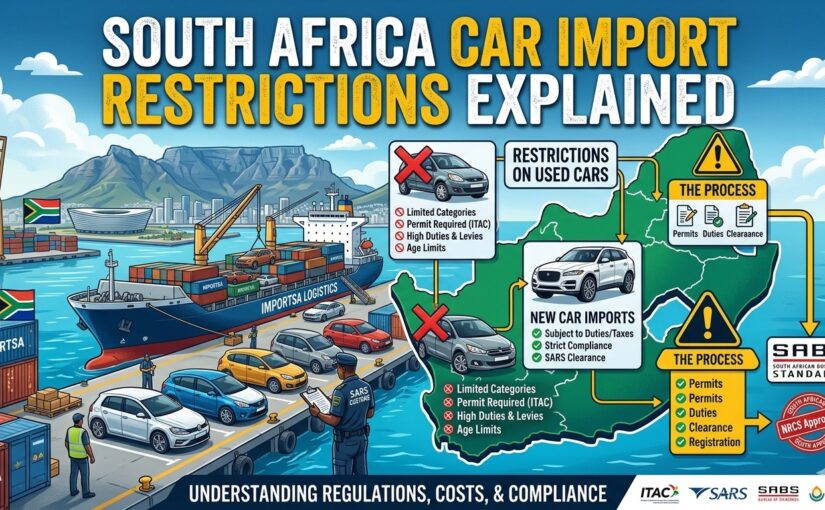
Vehicle Import Restrictions in South Africa — What You Need to Know Before You Ship
South Africa is a country that runs on wheels. From the wide highways of Gauteng to the breathtaking coastal roads of the Western Cape, having your own vehicle isn’t just a convenience — it’s a way of life. So if you’re relocating to South Africa, returning home after years abroad, or bringing a cherished vehicle into the country, it’s completely understandable that you’d want your own car making the journey with you.
But here’s something that surprises a great many people: South Africa has some of the most specific and strictly enforced vehicle import restrictions in the world. Unlike shipping a car to some other destinations, you can’t simply decide to bring any vehicle in. There are eligibility rules, permit requirements, safety compliance checks, and significant duties and taxes that all need to be carefully navigated — before your car even leaves the UK.
At Ship Cars Ltd, South Africa is a route we know inside out. This guide gives you an honest, clear breakdown of everything you need to understand before your vehicle sets sail.
Who Is Actually Allowed to Import a Used Vehicle?
This is the question that stops most people in their tracks — and rightly so. South Africa’s import regulations are specifically designed to protect the country’s domestic motor manufacturing industry, which means the importation of used vehicles is tightly restricted and not open to everyone.
Under the International Trade Administration Act (No. 71 of 2002), all used or second-hand vehicles require an import permit from the International Trade Administration Commission of South Africa (ITAC) before shipping. ITAC only issues permits under specifically defined circumstances.
Here is who qualifies:
- Returning South African nationals — You must have lived abroad for a minimum of six months for work, study, or research purposes, with the vehicle registered in your name for that entire period. You may import up to three vehicles, but all must remain in your ownership for at least two years after importation.
- New immigrants with permanent residence — If the Department of Home Affairs has granted you permanent residence status in South Africa, you are eligible to apply. Your vehicle must have been registered in your name abroad.
- Foreign diplomats — Diplomats are granted duty exemptions, subject to a clearance certificate and proof of the vehicle’s value.
- Physically disabled individuals — Vehicles specifically adapted for disability use can be imported with the appropriate medical certification and rebate permit.
- Inherited vehicles — If you’ve inherited a vehicle, you’ll need the deceased’s documents, a copy of the will, and a death certificate.
- Vintage and collector’s vehicles — Vehicles that are 40 years or older may be imported as collector’s items with the required affidavit and proof of collector status.
- Racing cars — Permitted strictly for track or circuit events only. These vehicles cannot be registered for use on public roads.
One rule that applies universally across almost all categories: imported vehicles cannot be sold, hired, or transferred for a minimum of 24 months from the date of importation. This is a firm condition attached to every import permit and is enforced seriously.
It is equally important to understand what South Africa does not permit: used vehicles intended for resale, commercial use, or sourced from bonded warehouses will not receive an import permit. Full stop.
The Right-Hand Drive Rule — Good News for UK Owners
Here is something that works very much in the favour of UK vehicle owners: South Africa drives on the left-hand side of the road, just like the United Kingdom. This means that right-hand drive vehicles are not only accepted but are the standard in South Africa.
Left-hand drive vehicles, on the other hand, face serious restrictions. Any left-hand drive vehicle that was not registered in South Africa before 23 July 2004 generally cannot be imported, licensed, or legally operated on South African public roads. There are narrow exceptions — such as vehicles over 25 years old or those destined for museum display — but for most purposes, if your vehicle is left-hand drive and isn’t a vintage piece, it won’t be crossing the South African border.
For UK owners with standard right-hand drive vehicles, this is one less hurdle to worry about.
The Two Permits You Must Obtain Before Shipping
Before your vehicle leaves the UK, you need to secure two separate permits. Attempting to ship without these in place is not just inadvisable — it can result in your vehicle being held at the port indefinitely or refused entry entirely.
- Letter of Authority (LOA) — from the NRCS
The National Regulator for Compulsory Specifications (NRCS) issues a Letter of Authority that confirms your vehicle meets South Africa’s mandatory safety and technical standards. Without it, your car cannot legally enter the country or be registered on South African roads.
To apply, you’ll need to complete Form LA01 and submit evidence that your vehicle conforms to South African safety, emissions, and technical specifications — typically verified against SABS, UN ECE, or EEC standards. The application fee ranges from approximately R300 to R1,800, and processing typically takes between 4 and 21 working days. Build this time into your planning from the very start.
For individual vehicle imports, a conditional LOA1 may be issued first — valid for 12 months — which allows you to bring the vehicle to the port. A final LOA1 is then issued after physical inspection on arrival.
- ITAC Import Permit — Form IE462
The ITAC Import Permit is obtained by completing Form IE462 (or Form IE463 for special categories such as vintage vehicles, inherited vehicles, or disability vehicles). ITAC does not charge a service fee for this application, but your eligibility must be clearly demonstrated through the supporting documents required for your specific category.
Both permits must be in hand before your vehicle is shipped. These are not documents you can chase retroactively once your car is at sea.
Customs Duties and Taxes — What to Expect
Let’s be straightforward: importing a vehicle into South Africa involves significant potential costs beyond the shipping freight itself, and understanding them upfront will prevent any unwelcome surprises on arrival.
Duty and VAT exemption for qualifying individuals:
If you are a returning South African national or a new immigrant permanently relocating, you may be eligible to import one motor vehicle free of customs duty and VAT. To qualify, you must:
- Have been the registered owner of the vehicle for at least 12 months prior to importation
- Be genuinely and permanently changing your place of residence to South Africa
- Commit to not selling, hiring, or disposing of the vehicle for a minimum of two years
To claim this exemption, you’ll complete SARS Form DA304A on arrival at customs.
For those who do not qualify for exemption, the following duty and tax rates apply:
- Customs duty — Up to 36% of the vehicle’s assessed value for vehicles under 20 years old; reduced to 20% for vehicles over 20 years old
- Ad Valorem duty — A sliding scale from 0.75% to 20% based on the vehicle’s market value; vehicles valued under R130,000 are generally exempt
- VAT — Charged at the standard South African rate of 15%, applied to the total assessed value including all duties
- Total tax burden — In some cases, cumulative taxes and duties can reach as much as 70% of the vehicle’s market value for high-value vehicles
SARS calculates customs value based on the declared value of the vehicle including freight and insurance costs. Accuracy is essential — undervaluing your vehicle will result in reassessment, penalties, and delays.
The Paperwork You’ll Need
Documentation requirements for South Africa are among the most comprehensive of any destination we ship to. Here is your complete checklist:
- Original V5C (Logbook) — The original vehicle title document, not a photocopy
- Passport copy — Photo page of the consignee
- Certified copy of the vehicle’s foreign registration certificate
- NRCS Letter of Authority (LOA) — Obtained before shipping
- ITAC Import Permit (Form IE462 or IE463) — Obtained before shipping
- Purchase invoice or official vehicle valuation — Used by SARS to calculate duties
- Bill of Lading — Issued by Ship Cars Ltd after your vehicle departs the UK
- SARS Form DA304A — Completed on arrival if applying for duty and VAT exemption
- Employer’s letter (for returning nationals) — Confirming permanent employment abroad and the period of employment
What Happens When Your Car Arrives in South Africa?
The primary port of entry for vehicle imports into South Africa is Durban, which handles the vast majority of automotive imports into the country.
Once your vehicle arrives and clears customs, the process doesn’t end there. Before your car can be registered and driven on South African roads, it must:
- Pass a roadworthiness test at an approved testing station — broadly equivalent to the UK MOT
- Receive a roadworthy certificate — costs approximately ZAR 200, with one free retest available within 14 days if required
- Be registered at a vehicle licensing office using the Customs Release Notification and the roadworthy certificate, along with your import documentation and proof of identity
Once registration is complete, you’ll receive a South African registration number and licence disc — and your vehicle is legally on the road.
Transit time from the UK to Durban via RoRo shipping is approximately 24 to 34 days, with monthly sailing schedules. Allow additional time for customs clearance, NRCS inspection, and roadworthy testing after vessel arrival.
Ship Your Car to South Africa with Confidence
South Africa’s vehicle import restrictions are complex — but they are navigable when you have the right expertise behind you. The most common and costly mistakes people make are starting the permit process too late, submitting incomplete documentation, or underestimating the duty and tax implications.
At Ship Cars Ltd, we guide every customer through South Africa’s requirements from the very first step. We’ll help you understand your eligibility, advise on permit applications, prepare your export documentation, and ensure your vehicle arrives at Durban ready for clearance — without unnecessary delays or surprises.