



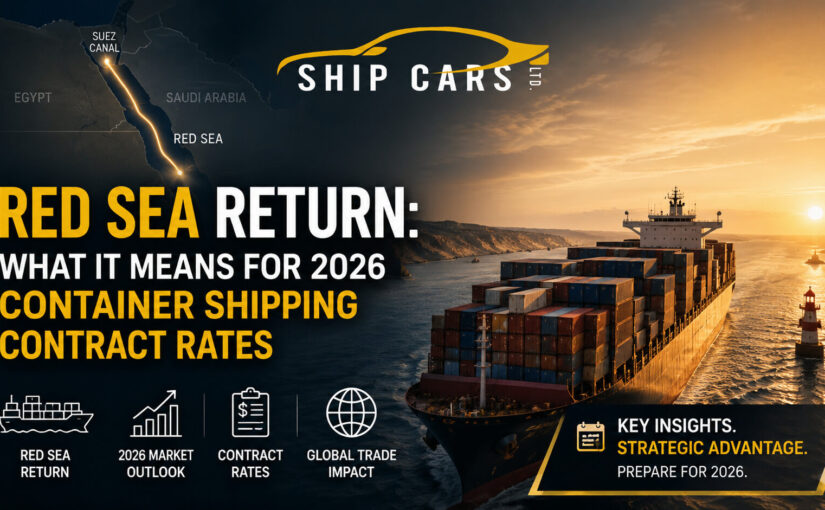
The Red Sea Is Reopening — But What Does That Actually Mean for You?
For over two years, the Red Sea has been one of the most disruptive forces in global container shipping. Since late 2023, Houthi attacks on commercial vessels in the Red Sea and Gulf of Aden forced the world’s major shipping lines to reroute their fleets around the Cape of Good Hope — adding up to 3,500 nautical miles and 10 to 14 extra days to voyages between Asia and Europe. The knock-on effects reached every corner of the shipping market, including the vehicle shipping routes that Ship Cars Ltd operates on every week.
Now, heading through 2026, something is shifting. Container shipping is tentatively returning to the Red Sea. Maersk completed its first transits through the waterway since attacks began. Egypt’s first semi-automated Red Sea container terminal opened at Sokhna Port in January 2026. Some carriers are testing Suez Canal routing again on select services.
But — and this is a significant but — the situation remains volatile. Other major carriers, including CMA CGM, have moved services back around the Cape of Good Hope following renewed concerns. The share of global container traffic transiting the Suez Canal remains at roughly 18–19%, well below the pre-crisis level of around 80%. Houthi threats have not disappeared. The ceasefire between Hamas and Israel remains fragile, and if that breaks down, analysts expect attack risk to rise again sharply.
So what does all of this mean for 2026 container Shipping Contract Rates — and for anyone shipping a vehicle internationally from the UK?
What Has Already Happened to Freight Rates
Understanding where rates are in 2026 requires understanding how dramatically they shifted over the previous two years.
When the Red Sea crisis began in late 2023, spot rates on Asia–Europe routes spiked rapidly. By mid-2024, freight rates between Shanghai and Rotterdam had increased by as much as 80% compared to pre-crisis levels. Carriers gained enormous pricing power as the longer Cape routing absorbed approximately two million TEU of global container fleet capacity — the equivalent of removing a significant share of the world’s shipping capacity from the market entirely.
By the time 2025 drew to a close, however, rates had already started to fall. Average spot rates had dropped below long-term contract rates on major trades. Carriers were heading toward loss-making territory on some routes. Global liner prices fell to around $2,107 per 40-foot container by late January 2026 — a significant retreat from crisis-era highs.
The message for shippers and vehicle exporters is this: the disruption-driven pricing premium that dominated 2024 and much of 2025 is unwinding. The question is how far it falls, and how quickly.
2026 Contract Rates — The Numbers Right Now
New long-term container shipping contracts entering validity in early 2026 have fallen to their lowest levels since before the Red Sea crisis began.
According to Xeneta market intelligence data:
- Average long-term rates from the Far East to North Europe in January 2026 stood at around $2,010 per FEU — down 10% on end-2025 levels and down 27% compared to the same point in 2025
- Average long-term rates from the Far East to the Mediterranean fell to approximately $2,308 per FEU — down 25% on end-2025
- Both trades have reached their lowest contract rate levels since 2023, before the Red Sea disruption inflated pricing
What is particularly notable is that new long-term contract rates are now, in some cases, coming in below the current spot market — particularly on Mediterranean trades, where the spread between spot and long-term rates stood at $2,200 per FEU in favour of contract pricing in January 2026.
This reflects what both shippers and carriers expect: that the market will continue to soften through 2026 as capacity is gradually released back into the system.
What a Full Red Sea Return Would Mean for Rates
The shipping industry is watching the Red Sea situation with considerable attention, because a large-scale return of container vessels to the Suez Canal route would be one of the most significant market events since the COVID-19 pandemic reshuffled global trade.
Here is the core dynamic: the Cape of Good Hope diversion is currently absorbing approximately two million TEU of global container fleet capacity simply by making voyages longer. If vessels return to the shorter Suez route, that capacity floods back into the market — significantly increasing supply without a corresponding increase in demand.
The rate implications are stark. Analysts at Xeneta have projected that freight rates could fall up to 25% globally in 2026 even without a large-scale Red Sea return. A rapid, full return would push rates down further — with HSBC analysts warning of an additional 10% decline, potentially pushing major carriers including Maersk and Hapag-Lloyd into loss-making territory.
Global container ship capacity is also projected to grow by around 36% between 2023 and 2027, according to Bloomberg Intelligence. New vessels continue to enter service regardless of what the Red Sea does. The combination of returning Red Sea capacity and a swelling global fleet means structural downward pressure on rates is likely to persist well into 2027.
The Risks That Could Push Rates Back Up
Falling rates are not guaranteed to be smooth or linear. There are several scenarios that could create short-term spikes even as the overall market trends downward:
Port congestion — If vessels return to the Suez Canal in significant numbers in a short period, European ports operating at full capacity could face severe congestion. An influx of earlier-than-expected arrivals would create backlogs, delay vessel turnarounds, and potentially drive short-term rate increases — particularly if the timing coincides with peak shipping seasons.
Houthi activity — The ceasefire remains fragile. Any resumption of sustained attacks would quickly push carriers back around the Cape, tightening capacity again and reversing recent rate declines. The situation in Yemeni territorial waters near Hodeidah is specifically flagged by security analysts as the highest-risk zone.
Black swan events — 2024 and 2025 demonstrated that unexpected disruptions can reshape global freight markets in weeks. War risk insurance premiums for Red Sea transit remain elevated, and many carriers require specific security assurances before committing to Suez routing on a sustained basis.
What This Means for Vehicle Shipping from the UK
For clients shipping vehicles from the UK internationally — whether by container or RoRo — the evolving Red Sea situation carries real practical implications.
Container Vehicle Shipping on routes between the UK, the Middle East, Asia, and beyond has been affected by the capacity constraints driven by the crisis. As rates soften and capacity normalises in 2026, vehicle shippers may benefit from improved pricing and more consistent sailing schedules on routes that were disrupted during the crisis period.
RoRo Vehicle Shipping operates on a separate vessel class from standard container services, but the broader freight market — including car carrier scheduling and port congestion — is influenced by the same underlying dynamics. Normalisation of container shipping capacity flows has positive downstream effects on the wider vehicle shipping market.
At Shipcars.co.uk, we monitor these developments continuously. The advice we give our clients on timing, routing, and shipping method is informed by real market conditions — not fixed tariffs or outdated pricing.
Real Examples — How Rate Changes Affect Our Clients
A UK motor trader exporting a consignment of vehicles to Jebel Ali, Dubai saw container shipping surcharges on their route increase significantly through 2024. Working with our team at Shipcars.co.uk, they locked in a pre-agreed rate ahead of a sailing date rather than booking at volatile spot prices — protecting their margin on the consignment.
A private client shipping a classic car from the UK to Sydney, Australia found that consistent communication from our team on sailing schedule changes during the Cape rerouting period allowed them to plan vehicle collection and Australian customs preparation accurately — avoiding the costly situation of a vehicle sitting at a UK port while sailing dates shifted.
The Ship Cars Ltd Position on 2026
We will be straightforward with you. The container shipping market in 2026 is in a transitional phase. Rates are falling from elevated crisis highs. The Red Sea is partially reopening but remains genuinely uncertain. New vessel capacity is entering a market where demand growth is soft.
For vehicle shippers, this creates both opportunity and risk. Lower contract rates and improving capacity availability are positive developments. But volatility — driven by geopolitics, port congestion, or sudden route changes — is not going away.
Our job at Shipcars.co.uk is to navigate that on your behalf. We know the routes, we track the market, and we book our clients’ vehicles with the experience needed to make the right call at the right time.
Shipcars.co.uk — International RoRo and Container Vehicle Shipping from the UK. Worldwide. Every Week.