



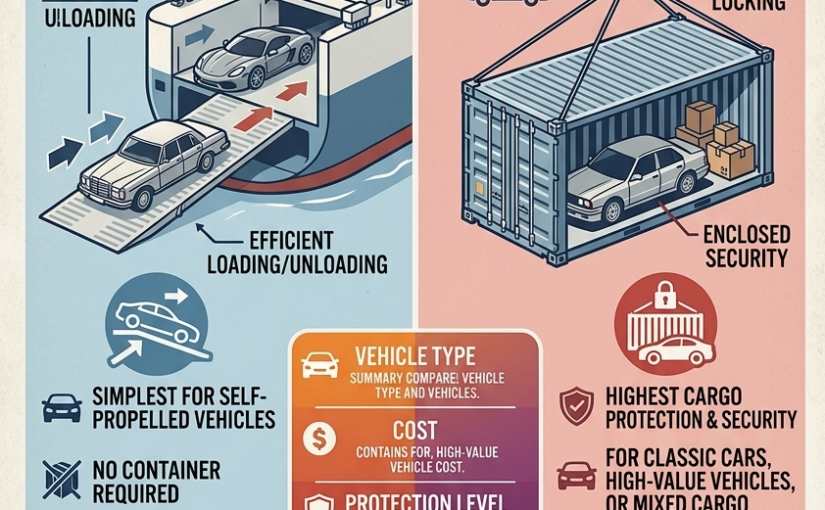
It is one of the first questions every client asks when they come to Ship cars ltd : should I ship my car by RoRo or container? It sounds like a simple choice, but the honest answer is that it depends on several factors — the type of vehicle you are shipping, where it is going, what your budget looks like, and how much protection you want during transit.
Both methods are safe, both are used every day on routes across the globe, and both have clear advantages depending on the situation. What matters is making the right choice for your specific vehicle and your specific circumstances — not simply going with whichever option is cheapest or whichever the shipping company finds most convenient to arrange.
This page walks you through both methods clearly and honestly, sets out the factors that should inform your decision, and explains how Ship cars ltd helps every client arrive at the right answer before the booking is confirmed.
Understanding RoRo Vehicle Shipping
Roll-on/Roll-off shipping — universally known as RoRo — is the most widely used method for international car shipping, and for very good reason. It is efficient, well-established, and available on frequent sailing schedules to most major global destinations.
The concept is exactly what the name suggests. Your vehicle is driven directly onto a purpose-built RoRo vessel — a large, multi-deck car carrier — secured in position for the voyage, and then driven off again on arrival at the destination port. The entire loading and discharge process is handled by trained terminal and vessel staff. No cranes, no lifting, no container loading — just a straightforward drive-on, drive-off operation that the shipping industry has refined over decades.
What makes RoRo the right choice for most vehicles:
- It is the most cost-effective method for standard passenger cars, SUVs, pickups, and light commercial vehicles
- Sailing frequency on major routes is high — particularly from key UK departure ports such as Southampton, Tilbury, and Bristol Portbury
- Transit times are reliable and well-documented for most global routes
- The loading and discharge process is lower-risk for standard vehicles than crane-lifted container loading
The limitations of RoRo that you need to know:
- Vehicles must be in full running condition — RoRo is not suitable for non-runners
- Personal belongings cannot be left inside the vehicle under any circumstances
- Electric vehicles cannot travel by RoRo due to lithium battery regulations imposed by all major shipping lines
- The fuel tank must be reduced to approximately one quarter full or less before port check-in
- Vehicles are exposed to the sea air environment on vessel decks, which is generally not an issue for standard cars but is a relevant consideration for very valuable or very vulnerable vehicles
For the vast majority of standard international car shipping requirements — a family car going to Australia, a used vehicle being exported to West Africa, a fleet of pickups heading to the Middle East — RoRo is the most practical and most cost-effective answer.
Understanding Container Vehicle Shipping
Container shipping places your vehicle inside a sealed steel shipping container for the entire duration of the voyage. The container is loaded onto a container vessel at the UK departure port and discharged at the destination port, where the vehicle is unloaded and presented for customs clearance.
There are two container configurations used for vehicle shipping:
- Sole use container — your vehicle is the only thing inside the container. This is the standard approach for classic cars, prestige vehicles, and any situation where maximum protection and security are priorities
- Shared container (groupage) — your vehicle shares a container with one or more other vehicles heading to the same destination. This reduces the cost while still providing the physical protection of the container environment
What makes container the right choice in specific situations:
- Classic and vintage cars — where protection from sea air, salt spray, and physical contact with other vehicles is non-negotiable
- Prestige and high-value vehicles — where the owner requires absolute peace of mind about the condition of the vehicle during transit
- Electric vehicles — all EVs must travel by container without exception. Lithium battery regulations prohibit RoRo shipping for electric vehicles across all major shipping lines globally
- Non-running vehicles — a car that cannot be driven cannot go on a RoRo vessel. Container shipping allows the vehicle to be winched or rolled into the container without requiring the engine to run
- Left-hand drive vehicles on certain routes — some destination ports have specific handling considerations for LHD vehicles that make container shipping preferable
- Personal effects alongside the vehicle — subject to destination country import regulations, container shipments can sometimes include a limited quantity of personal belongings packed inside or around the vehicle. This is destination-dependent and must be declared correctly
The practical considerations for container shipping:
Container shipping is generally more expensive than RoRo for the same route, reflecting the additional handling, equipment, and sole-use space involved. On very busy global trade routes — such as UK to Australia or UK to the USA — the price difference can be significant. On less frequently served routes, the gap narrows.
Loading and discharge timings for container shipping are also typically slightly longer than RoRo, as the container must be loaded, sealed, and moved through the container terminal rather than driven directly to the vessel.
The Factors That Should Drive Your Decision
At Ship cars ltd, we ask every client a consistent set of questions before recommending a shipping method. Here is how those factors map to the decision:
Vehicle type and value — A standard used hatchback going to Lagos? RoRo is perfectly appropriate. A 1968 Jaguar E-Type going to a collector in California? Container, without question. The value and vulnerability of the vehicle is the most important single factor in this decision.
Running condition — If the vehicle cannot be driven, the decision is already made. It must go by container.
Electric or hybrid powertrain — EVs go by container. Full stop. This is not a choice; it is a regulatory requirement.
Destination — Some destinations are primarily served by RoRo, with container shipping available but less frequent. Others have strong container services and limited RoRo options. The destination shapes what is actually available to book.
Budget — If cost is the primary consideration and the vehicle is a standard car in good running condition, RoRo will almost always be the more affordable option. If the vehicle is valuable enough that any risk of cosmetic damage during transit would be a serious concern, the additional cost of container shipping is money well spent.
Personal effects — If you need to ship belongings alongside the vehicle, container is the only option worth considering. Check destination import regulations first, as some countries treat personal effects shipped in a vehicle container very differently from others.
Timeline — On certain routes, RoRo sailings are more frequent than container services, meaning a faster departure may be achievable via RoRo. On other routes, container services are actually more regular. We check both when advising clients on timing.
A Direct Comparison — RoRo vs Container at a Glance
| Factor | RoRo | Container |
|---|---|---|
| Cost | Lower | Higher |
| Protection level | Standard | Maximum |
| Suitable for EVs | ❌ No | ✅ Yes |
| Suitable for non-runners | ❌ No | ✅ Yes |
| Personal effects allowed | ❌ No | ✅ Destination-dependent |
| Classic/prestige vehicles | Possible but not ideal | ✅ Recommended |
| Sailing frequency | High on major routes | Varies by route |
| Transit time | Reliable | Slightly longer loading process |
Real Examples from Ship cars ltd
A client in Nottingham was initially set on RoRo shipping for his BMW 5 Series to Houston, Texas — purely on cost grounds. When we discussed the route, we identified that a shared container groupage option was available for a modest additional cost, providing full container protection for a vehicle he had maintained in excellent condition. He chose container. The vehicle arrived in Houston without a mark on it.
A Leeds-based motor trader exporting ten used Nissan pickups to Mombasa, Kenya needed cost efficiency across the consignment. All ten vehicles were in full running condition and standard specification. RoRo was the straightforward and correct answer — the consignment shipped from Tilbury, and the per-vehicle cost was exactly what the trader needed to maintain margin on the deal. All ten vehicles arrived and cleared Mombasa without issue.
A private client in London needed to ship a Tesla Model S to Sydney, Australia. The vehicle was electric, immediately ruling out RoRo. We arranged a sole-use container from Southampton, managed the battery state-of-charge protocol, and coordinated collection from the client’s home in West London. The vehicle arrived in Sydney in exactly the condition it left the UK.
A classic car enthusiast in Edinburgh was shipping a fully restored Austin-Healey 3000 to a buyer in Toronto. The car had taken three years to restore and was valued at over £60,000. Container was the only answer we recommended — and the client agreed immediately. The vehicle was professionally loaded into a sole-use container at Bristol Portbury, secured with professional tie-downs, and arrived in Toronto in perfect condition.
How Ship cars ltd Makes the Decision Simple
We do not push clients toward one method or the other based on what is simpler for us to arrange. We ask the right questions, understand the vehicle, understand the destination, and give you a clear, honest recommendation based on what actually makes sense for your situation.
In some cases the answer is obvious from the first conversation. In others — particularly where cost and protection are pulling in different directions — we walk through the options together and help you make an informed decision.
What we never do is book a vehicle onto a service that is not appropriate for it, or allow a client to make a choice without understanding what it means in practice.That is the Ship cars ltd standard. Clear advice, honest pricing, and a shipping method chosen for the right reasons.Ship cars ltd — International RoRo and Container Shipping from the UK. Worldwide. Every Week.